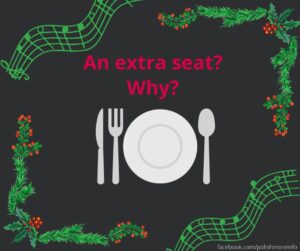
Do you know in Poland, there is a custom to leave one empty seat at the festive dinner table on the day of Wigilia [1] the Christmas Eve ? There are two explanations for this. According to the first one – this is a place for an unexpected guest, cause – especially this evening – noone should be denied hospitality. The second one says the seat is for the dearly departed and for those we miss. And this 1999 Polish Christmas carol is created with this second meaning at its core:
(Fair warning: it is sad. But at the same time – full of hope.)
A nadzieja znów wstąpi w nas,
nieobecnych pojawią się cienie.
Uwierzymy kolejny raz
w jeszcze jedno Boże Narodzenie.
I choć przygasł Świąteczny gwar,
bo zabrakło znów czyjegoś głosu,
przyjdź tu do nas i z nami trwaj,
wbrew tak zwanej ironii losu.
Daj nam wiarę, że to ma sens,
że nie trzeba żałować przyjaciół,
że gdziekolwiek są dobrze im jest,
bo są z nami choć w innej postaci.
I przekonaj, że tak ma być,
że po głosach tych wciąż drży powietrze,
że odeszli po to, by żyć
i tym razem będą żyć wiecznie.
Przyjdź na świat,
by wyrównać rachunki strat.
żeby zająć wśród nas,
puste miejsce przy stole.
Jeszcze raz pozwól cieszyć się dzieckiem w nas
i zapomnieć, że są puste miejsca przy stole.
Text by Szymon Mucha.
And hope will fill us again
those who left will appear as shadows [2]literally: the shadows of the absent will appear
And we’ll start to believe once again
In yet another instance of Christmas [3]I think the holiday’s name meaning – literally “the birth of God” – is much more direct, preasent and inseparable from religion in Polish “Boże … Continue reading
And though holiday cheer’s dimmed down,
Cause another one’s voice is missing
Come to us and with us stay
To defy so called irony of fate
Give us faith that it all makes sense
That for friends noone needs be in mourning [4] Literally: That there’s no need to mourn friends
That wherever they are, they are well,
Cause they’re with us, though not in their bodies [5] Literally: Cause they’re with us, although in different form .
And convince us it’s as should be
That the air still vibrates of those voices
That they left, so that they could live
And this time they will live forever
Come to the world,
to even the scores of the lost [6] Literally: of the loses
To take among us
the empty seat at our table
Once again let us feel joy of inner child [7] Literally: Let us enjoy the child inside us
and forget that there are empty seats at our table
This attempt at translation is mine. ose
There is also an English cover of this by Cliff Richard – the title’s “Come to us” – but the reference to the empty seats is – understandably – lost in that version of the song.
[+]
| ↑1 | the Christmas Eve |
|---|---|
| ↑2 | literally: the shadows of the absent will appear |
| ↑3 | I think the holiday’s name meaning – literally “the birth of God” – is much more direct, preasent and inseparable from religion in Polish “Boże Narodzenie” than in English “Christmas” |
| ↑4 | Literally: That there’s no need to mourn friends |
| ↑5 | Literally: Cause they’re with us, although in different form |
| ↑6 | Literally: of the loses |
| ↑7 | Literally: Let us enjoy the child inside us |